SCSJ 4423 – Real-Time Software Engineering
Consolidated Study Notes (Chapters 5–9)
Exam-prep summary covering Concurrency, Mechanisms to Support Concurrency, RTOS, and Real-Time Scheduling & Schedulability Analysis.
Table of Contents
- Chapter 5 – Introduction to Concurrency
- Chapter 6 – Mechanisms to Support Concurrency
- Chapter 7 – Concurrent Programming in Practice (BACI/jBACI)
- Chapter 8 – Real-Time Operating Systems (RTOS)
- Chapter 9 – Real-Time Scheduling & Schedulability Analysis
- Quick Formula Sheet
Chapter 5 – Introduction to Concurrency
What is Concurrency?
- Concurrency = the ability of a system to handle multiple tasks that are in progress at the same time (their lifetimes overlap), whether or not they physically execute simultaneously.
- It is about dealing with many things at once (structure); parallelism is about doing many things at once (execution).
Concurrency vs. Parallelism
| Aspect | Concurrency | Parallelism |
|---|---|---|
| Definition | Tasks make progress in overlapping time periods | Tasks execute literally at the same instant |
| Hardware | Possible on a single processor (interleaving) | Requires multiple processors/cores |
| Mechanism | Interleaving (time-sharing one CPU) | Overlapping (true simultaneous execution) |
| Goal | Structure / responsiveness | Speed-up / throughput |
- Interleaving – one processor rapidly switches among tasks → appears simultaneous (semi/pseudo concurrency).
- Overlapping – multiple processors run tasks at the same real time (true concurrency).
Types of Concurrency
- Semi (pseudo) concurrency – single processor, achieved by interleaving/time-slicing.
- True concurrency – multiple processors executing simultaneously (parallelism).
Process vs. Thread
| Process | Thread | |
|---|---|---|
| Definition | Program in execution with its own address space | Lightweight unit of execution within a process |
| Memory | Separate (isolated) memory space | Shares the process's memory/resources |
| Overhead | Heavy (context switch expensive) | Light (fast to create/switch) |
| Communication | IPC (message passing, pipes) | Shared variables (needs synchronization) |
| Terms | Multiprogramming = many processes | Multithreading = many threads in one process |
Sequential vs. Concurrent
- Sequential program – single thread of control; statements execute one after another in a defined order.
- Concurrent program – multiple threads of control that may execute in parallel or be interleaved.
- Concurrent system – the executing environment (hardware + OS + RTSS) that supports concurrent programs.
- Concurrent program – the software describing the cooperating tasks.
Nature of Concurrent Systems
- Tasks are (largely) independent but may need to cooperate and compete for shared resources.
- Execution order between independent tasks is non-deterministic (not fixed).
The 6 Problems in Concurrent Programming
- Violating mutual exclusion – two tasks in their critical section simultaneously → corrupted shared data.
- Deadlock – tasks each hold a resource and wait for another's → all blocked forever.
- Starvation / Lockout – a task is perpetually denied a needed resource.
- Transient error – timing-dependent intermittent fault (hard to reproduce).
- Busy waiting – a task wastes CPU cycles continuously polling instead of blocking.
- Unfairness – resource allocation is not equitable among tasks.
Chapter 6 – Mechanisms to Support Concurrency
Two Forms of Concurrency
- Hardware concurrency – true parallelism on multiprocessor/multi-core hardware.
- Software concurrency – logical concurrency created by the OS/RTSS via interleaving on (possibly) one CPU.
Non-Determinism – the echo() Example
When two tasks call a shared echo() (read char → store → write) without protection, interleaved execution can lose or duplicate characters. This illustrates why unsynchronized access to shared data produces unpredictable (non-deterministic) results — the motivation for mutual exclusion.
Mutual Exclusion (MUTEX)
Ensures only one task accesses a shared resource / critical section at a time.
Critical Section (CS) structure:
entry section      // request permission to enter
    CRITICAL SECTION   // access shared resource
exit section       // release
remainder section  // non-critical work
MUTEX requirements (a correct solution must satisfy):
- Mutual exclusion – at most one task in the CS at any time.
- Progress – if no task is in the CS, a waiting task must be allowed in (no needless blocking).
- Bounded waiting – a task waits only a finite time (no starvation).
- No assumptions about relative speed or number of processors.
3 Approaches to Satisfy Mutual Exclusion
- Semaphore – integer variable with atomic
wait()/P()andsignal()/V()operations. - Binary semaphore (0/1) → mutex lock. - Counting semaphore → manages N instances of a resource. - Monitor – high-level construct encapsulating shared data + procedures; only one task may be active in the monitor at a time (mutual exclusion is automatic). Uses condition variables (
wait/signal). - Message Passing – tasks synchronize/communicate by send/receive messages (no shared memory needed). Can be synchronous (blocking) or asynchronous (non-blocking).
Concurrent Programming (CP) Constructs
- Fork/Join, cobegin/coend (or
PAR), and explicit task/thread declarations mark statements to run concurrently.
Concurrent Programming Languages
| Language | Concurrency Construct | Notes |
|---|---|---|
| Ada | task, PAR |
Rendezvous model for task communication; designed for embedded/real-time. |
| OCCAM | SEQ, PAR, ALT |
Based on CSP; designed for the transputer; channels for message passing. |
| Java | Thread class / Runnable interface |
synchronized, wait(), notify(); monitors built in. |
| Concurrent C-- / BACI | cobegin … coend |
Used in labs (BACI = Ben-Ari Concurrent Interpreter); semaphores. |
Run-Time Support System (RTSS)
- The layer beneath a concurrent program that manages tasks: creation, scheduling, context switching, synchronization.
- Implements time-slicing – divides CPU time into small slices allocated to tasks in turn.
- Context switch – saving one task's state (registers, PC, stack) and restoring another's.
Two Ways to Achieve Concurrency in Real-Time Systems
- Concurrent language (Ada/OCCAM/Java) – concurrency is built into the language; RTSS provided by the language runtime.
- Sequential language + RTOS – e.g., C + µC/OS-II; the RTOS kernel provides tasking. Tasks created via calls like:
c
   OSTaskCreate(TaskFunc, &data, &TaskStk[STKSIZE], priority);
Chapter 7 – Concurrent Programming in Practice (BACI/jBACI)
- jBACI – Java-based IDE/simulator for the BACI (Ben-Ari Concurrent Interpreter) system, used to write, compile, and visualize concurrent programs.
- Supports Concurrent C-- and Concurrent Pascal dialects.
- Key constructs practiced in labs:
cobegin p1(); p2(); coend;– run procedures concurrently.- Semaphores:
semaphore s;,initialsem(s, val),p(s)(wait),v(s)(signal). mutexfor binary locks.- Purpose: observe non-determinism, demonstrate race conditions, and verify that semaphores/monitors enforce mutual exclusion. Different runs of the same program can give different interleavings/outputs.
Chapter 8 – Real-Time Operating Systems (RTOS)
Definition
An RTOS is an OS that guarantees tasks complete within deterministic, predictable time bounds — correctness depends on both logical result and timing. It is an abstraction layer between application software and hardware.
RTOS vs. Generic (General-Purpose) OS
| Feature | RTOS | Generic OS |
|---|---|---|
| Design goal | Predictability / determinism | Throughput & fairness (average performance) |
| Scheduling | Priority-based, preemptive | Time-sharing / fair-share |
| Latency | Bounded, guaranteed | Variable, best-effort |
| Kernel | Small, deterministic | Large, feature-rich |
| Timing | Deadlines are critical | Deadlines not guaranteed |
| Example | µC/OS-II, VxWorks, FreeRTOS | Windows, Linux, macOS |
RTOS Structure
- Executive + Kernel model:
- Kernel – the core: task scheduling, dispatch, context switching, inter-task synchronization/communication.
- Executive – kernel + additional services (memory management, I/O, timers, device drivers).
RTOS Services
- Task management (create/delete/suspend/resume)
- Scheduling & dispatching (priority-based preemptive)
- Inter-task communication & synchronization (semaphores, mailboxes, message queues)
- Time management (delays, timeouts, system tick)
- Memory management
- Interrupt handling
µC/OS-II (Micrium)
- Portable, ROMable, scalable, preemptive, multitasking real-time kernel for microprocessors/microcontrollers.
- Priority-based preemptive scheduling; each task has a unique priority.
- Deterministic (execution times are known/bounded).
- Written mostly in C (small portion in assembly for portability).
- Supports up to a fixed number of tasks, each with its own stack.
- Common API:
OSInit(),OSStart(),OSTaskCreate(),OSTimeDly(),OSSemPend(),OSSemPost().
Chapter 9 – Real-Time Scheduling & Schedulability Analysis
Part 1 – Scheduling Fundamentals
Scheduling = deciding the order and timing in which tasks use the processor so that timing constraints (deadlines) are met.
Goals of Real-Time (ERT) scheduling: meet all deadlines, maximize processor utilization, ensure predictability, minimize response time.
Task Model Parameters
| Symbol | Meaning |
|---|---|
| T | Period (time between successive releases of a periodic task) |
| D | (Relative) Deadline — often D = T |
| C | WCET — Worst-Case Execution Time (compute time) |
| R | Response time (release → completion) |
| a / S | Arrival / start time |
| U | Utilization = C / T |
Task Types
- Periodic – released at fixed regular intervals (period T).
- Aperiodic – released irregularly; soft deadlines; random arrival.
- Sporadic – irregular arrival but with a minimum inter-arrival time; typically hard deadlines.
Scheduling Classification
- Pre-run-time (offline / static) – schedule computed before execution (e.g., cyclic executive). Predictable, inflexible.
- Run-time (online / dynamic) – decisions made during execution based on priorities.
- Fixed priority – priority set once and never changes (e.g., RM).
- Dynamic priority – priority changes at run time (e.g., EDF).
Basic Scheduling Policies
- Cyclic (cyclic executive) – fixed repeating timeline of task slots.
- Time-slicing (round-robin) – equal CPU quanta rotated among tasks.
- Priority-based (preemptive) – highest-priority ready task runs; can preempt lower priority.
Rate Monotonic (RM) vs. Earliest Deadline First (EDF)
| Rate Monotonic (RM) | Earliest Deadline First (EDF) | |
|---|---|---|
| Priority type | Fixed (static) | Dynamic |
| Priority rule | Shorter period T → higher priority | Earliest absolute deadline → higher priority |
| Assignment time | Offline (once) | At run time (recomputed) |
| Utilization bound | ≤ n(2^(1/n) − 1) (≈0.693 as n→∞) | ≤ 1 (100%) |
| Optimality | Optimal among fixed-priority schemes | Optimal among all schemes |
| Overhead | Low | Higher (deadline tracking) |
| Implementation | Simple, common in RTOS | More complex |
Part 2 – Schedulability Analysis (SA)
Schedulability Analysis determines whether a given set of tasks can be successfully scheduled (every task completes by its deadline) under a specific algorithm. A Schedulability Test (ST) validates that deadlines are met. (Scheduling with resource dependencies is NP-hard.)
3 Basic Approaches
- Processor Utilization Analysis
- Processor Workload Analysis
- Response Time Analysis
1) Processor Utilization Analysis
ST 1 — EDF (Di ≥ Ti, periods integer multiples). Necessary & sufficient:
ST 2 — RM. Necessary & sufficient (sufficient bound, Liu & Layland):
Utilization bound U(n) values:
| n | U(n) bound |
|---|---|
| 1 | 1.000 |
| 2 | 0.828 |
| 3 | 0.779 |
| 4 | 0.756 |
| 5 | 0.743 |
| ∞ | 0.693 |
Worked example — Mobile Robot (RM):
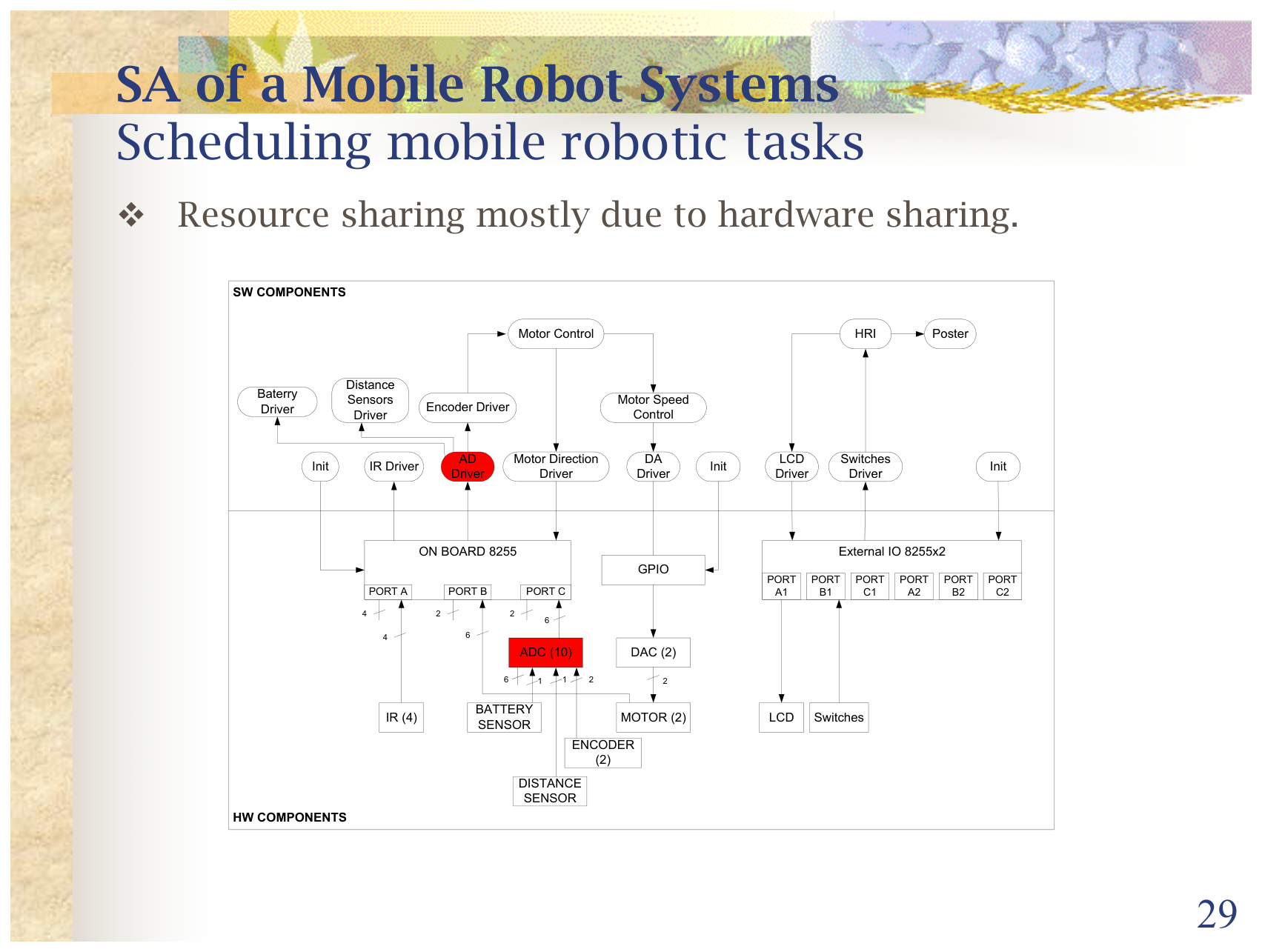
| Task | Tᵢ | Cᵢ | Cumulative U | U(n) bound | Schedulable? |
|---|---|---|---|---|---|
| MotorControlKanan | 50 | 12 | 0.24 | 1.00 | ✅ |
| MotorControlKiri | 50 | 12 | 0.48 | 0.828 | ✅ |
| AvoidBehavior | 250 | 20 | 0.56 | 0.779 | ✅ |
| MobileRobot | 300 | 10 | 0.59 | 0.756 | ✅ |
| HRI | 500 | 125 | 0.84 | 0.743 | ❌ (0.84 > 0.743) |
- First 4 tasks → U = 0.59 ≤ 0.756 → schedulable.
- Adding HRI (5th) → U = 0.84 > 0.743 → NOT schedulable by the utilization test.
- ⚠️ The utilization test is sufficient but not necessary for RM: failing it doesn't prove infeasibility — use Response Time Analysis for an exact answer.
2) Processor Workload Analysis
ST 3 — RM. Task Jᵢ is schedulable iff there exists a time instant t where the cumulative workload fits:
The inequality Wᵢ(t) ≤ t must hold for some t chosen from:
- If Di ≠ Ti, replace Tᵢ with min(Di, Tᵢ).
3) Response Time Analysis (RTA)
ST 4 — RM. Task i is schedulable if Rᵢ ≤ Dᵢ, where R is found by the recurrence:
- hp(i) = set of tasks with higher priority than i (shorter periods under RM).
- ⌈ ⌉ = ceiling. The second term = interference from higher-priority tasks.
Iteration algorithm:
- Step 1: first approximation
a₀ = Σ Cⱼ(sum of C of task i and all higher-priority tasks). - Step 2: compute next
aₙ₊₁from the recurrence. - Step 3: check:
- Cond. 1:
aₙ₊₁ ≤ DᵢANDaₙ₊₁ ≠ aₙ→ repeat Step 2. - Cond. 2:
aₙ₊₁ > Dᵢ→ misses deadline (not schedulable). - Cond. 3:
aₙ₊₁ = aₙ→ converged;aₙ= response time (WCRT). Schedulable if ≤ D.
Worked example — Mobile Robot task "Subsumption" (T=200, D=200, C=1; higher-priority: MobileRobot C=1/T=50, Motorctrl_left C=20/T=50, Motorctrl_right C=20/T=50):
- Step 1:
a₀ = 1 + 20 + 20 + 1 = 42 - Step 2:
a₁ = 1 + ⌈42/50⌉·1 + ⌈42/50⌉·20 + ⌈42/50⌉·20 = 1 + 1 + 20 + 20 = 42 - Step 3:
a₁ = a₀ = 42(Cond. 3) → WCRT = 42 ms ≤ D = 200 ms → schedulable ✅
Full mobile-robot timing results (Di = Ti):
| Task | Period T | WCET C | Rᵢ | Schedulable (R ≤ D)? |
|---|---|---|---|---|
| MobileRobot | 50 | 1 | 1 | ✅ |
| Motorctrl_left | 50 | 20 | 21 | ✅ |
| Motorctrl_right | 50 | 20 | 41 | ✅ |
| Subsumption | 200 | 1 | 42 | ✅ |
| Avoid | 300 | 17 | 100 | ✅ |
| Cruise | 300 | 1 | 143 | ✅ |
| Manrobotintf | 500 | 16 | 200 | ✅ |
➡️ Even though the utilization test failed for the full set, RTA proves every task meets its deadline — RTA is exact (necessary & sufficient) while the utilization bound is only sufficient.
Worked example 2 — RTA convergence (task e₃: T=350, C=100, D=350; hp = e₁ T=100/C=40, e₂ T=150/C=40):
a₀ = 100 + 40 + 40 = 180a₁ = 100 + ⌈180/100⌉·40 + ⌈180/150⌉·40 = 100 + 2·40 + 2·40 = 260a₂ = 100 + ⌈260/100⌉·40 + ⌈260/150⌉·40 = 100 + 3·40 + 2·40 = 300a₃ = 100 + ⌈300/100⌉·40 + ⌈300/150⌉·40 = 100 + 3·40 + 2·40 = 300a₃ = a₂ = 300→ WCRT = 300 ms ≤ 350 ms → schedulable ✅
Quick Formula Sheet
| Concept | Formula |
|---|---|
| Utilization of one task | Uᵢ = Cᵢ / Tᵢ |
| Total utilization | U = Σ (Cᵢ / Tᵢ) |
| EDF bound (nec. & suff.) | U ≤ 1 |
| RM utilization bound (suff.) | U ≤ n(2^(1/n) − 1) |
| RM bound as n→∞ | ≈ 0.693 |
| Workload (RM) | Wᵢ(t) = Σₖ Cₖ⌈t/Tₖ⌉, test Wᵢ(t) ≤ t |
| Response time (RM) | Rᵢˣ⁺¹ = Cᵢ + Σ_{j∈hp(i)} ⌈Rᵢˣ/Tⱼ⌉ Cⱼ |
| Schedulable (RTA) | Rᵢ ≤ Dᵢ |
| First approx. | a₀ = Σ Cⱼ (task i + all hp) |
Key exam reminders
- RM → shorter period = higher priority; EDF → nearest deadline = higher priority.
- Utilization test is sufficient only for RM (a pass guarantees schedulable; a fail is inconclusive).
- Response Time Analysis is exact (necessary & sufficient) for fixed-priority preemptive scheduling.
- Ceiling ⌈ ⌉ in RTA/workload; floor ⌊ ⌋ in the workload's time-instant set.
hp(i)= higher-priority tasks only (they interfere with i; lower-priority tasks do not).
Notes compiled from Chapters 5–9 lecture slides (Topic 5 Concurrency, Topic 5 Mechanisms, Topic 7 RTOS, Topic 8 RT Scheduling Parts 1 & 2, Processor Utilization & Response Time Analysis). Source folders left unmodified.